

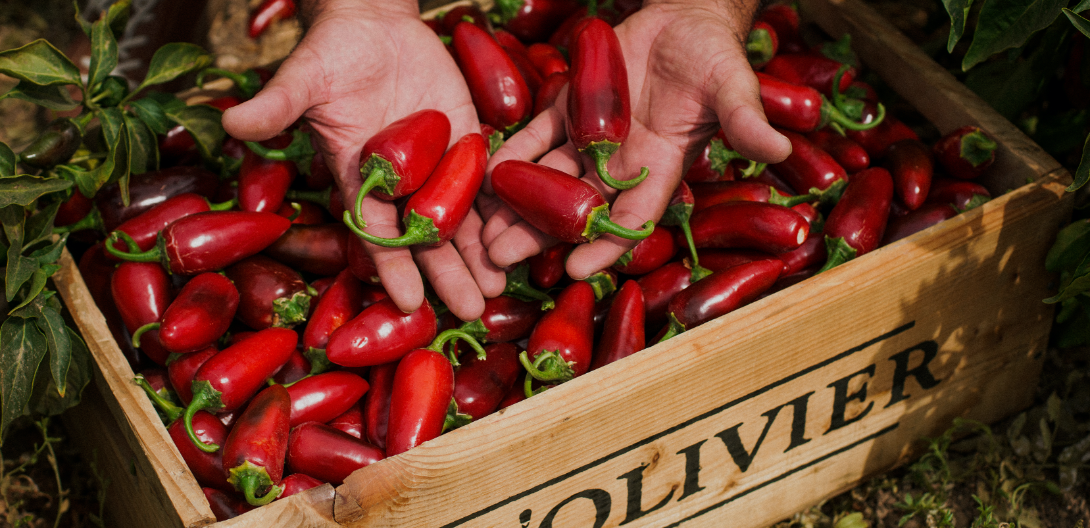
Origin of chili peppers
A spotlight on the history, uses, varieties, benefits, and cuisine of chili peppers. The word refers to both a plant, its fruit, and one of the most well-known – and consumed – spices in the world.
History of chili peppers
While chili peppers are now found in most cuisines worldwide, this plant from the Solanaceae family – like potatoes, tomatoes, or eggplants – originated in South and Central America. Native Americans cultivated and consumed it thousands of years ago, and the Aztecs even associated it with cocoa!
However, it was not until the late 15th century, following Christopher Columbus's expeditions, that chili peppers reached Europe, where they competed with black pepper, which was rarer and more expensive. On the Old Continent, this "red gold" was first introduced in Spain. Portuguese and Spanish navigators then transported it to Asia and Africa. It is now present on almost every continent.
How is its heat measured?
Chili pepper is generally associated with a pungent flavor or, more precisely, a burning sensation. This depends notably on the capsaicin content, a chemical compound whose quantity determines the strength of the chili. In 1912, an American pharmacologist named Wilbur Scoville developed a classification method consisting of crushing several types of fresh chilies, diluting the resulting puree in sugary water, and then having tasters sample this solution.
"Scoville units" thus correspond to the number of dilutions required for the burning sensations to disappear. They range from 0 to over 3,000,000 for the hottest chilies! For simplicity, they are often presented on a scale of 0 to 10: neutral (0), mild (1), warm (2), lively (3), hot (4), strong (5), fiery (6), burning (7), scorching (8), volcanic (9), and explosive (10). In recent years, Americans have created, through crossbreeding, ultra-hot varieties that break all records, such as the aptly named "Carolina Reaper" or "Pepper X."
What are the different varieties of chili peppers?
The consumed varieties belong to five major domesticated species. The most cultivated in the world, Capsicum Annuum, includes bell pepper (which is not spicy at all and represents a value of 0 on the Scoville scale), mild chili (1) used to make paprika, and jalapeño (5). And what about Espelette pepper? Protected by a Protected Designation of Origin (PDO), this French chili, traditionally dried on the walls of Basque Country houses, is classified among the "hot" chilies (4).
The Capsicum frutescens species concerns less cultivated varieties, with the exception of stars such as Cayenne pepper (8), the small West Indian bird pepper (9), or the famous tabasco (6) used to make the sauce of the same name. The explosive habanero (10) belongs to the Capsicum chinense family, which does not come from China but from South America. Finally, the Capsicum baccatum and Capsicum pubescens species include much more confidential varieties.


Leave a comment
This site is protected by hCaptcha and the hCaptcha Privacy Policy and Terms of Service apply.