

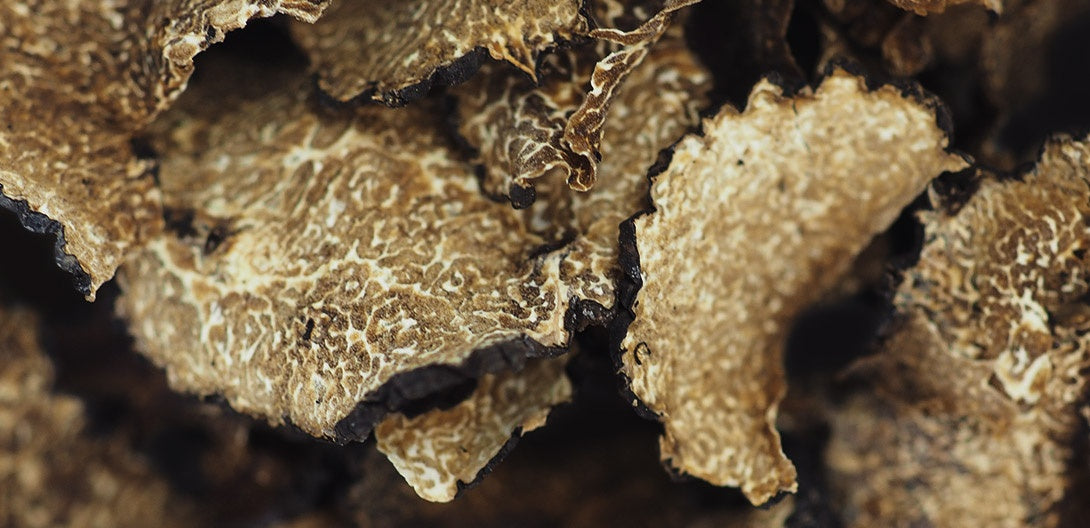
Where and how do truffles grow?
The truffle is the fruit of a mycelium, a network of filaments forming the underground vegetative part of fungi. It thrives in calcareous soils, where it lives in symbiosis with the roots of certain trees: mainly oaks (especially the green oak, favored by truffle growers because it produces quickly), but also hazelnut, linden, and ash trees. The mycelium forms a cozy web that gives birth, in spring, to the precious black diamond, which grows in summer and develops its taste properties in autumn. Wild truffles are now almost non-existent, so truffle growers plant trees whose roots have been inoculated with truffle mycelium (known as mycorrhizal plants), particularly truffle oaks, then wait several years before being able to harvest the precious black fungus. In France, truffle grounds are mainly found in the South-West and South-East.
How are truffles harvested?
Harvesting, or "cavage," begins after the first frosts, when truffles are at their peak maturity. Since the human nose is unable to detect their presence underground, the assistance of a trained dog or a sow is essential. When, in the grass-free areas around the trees, the animal starts scratching the ground or rooting, the owner knows that's where he needs to dig! All he has to do is unearth or "caver" the truffle. Certain flies, which lay their eggs just above truffles, also help experienced "caveurs" find their treasure.
How long have truffles been consumed?
At least since antiquity! Sumerian clay tablets dating back to 3700 BC already mention truffles. It is also said that in ancient Egypt, Pharaoh Khufu was fond of them and had truffle-based dishes prepared for his foreign guests. For the Greek philosopher Theophrastus (4th and 3rd centuries BC), truffles were generated by autumn rains accompanied by thunder. In the Roman world, which particularly appreciated Libyan truffles, Cicero (106-43 BC) believed they were "children of the earth." As for Pliny the Elder (1st century AD), he considered them "calluses" of the earth and miracles of nature.
From malevolent fungus to black diamond
In the Middle Ages, however, truffles fell out of favor: dark, mysterious, and underground, they were associated with Satan. In the 16th century, King Francis I reintroduced them to the court. They were then thought to have aphrodisiac properties! They reached their peak in the 19th century, and in 1825, the gastronome Brillat-Savarin gave them the nickname "diamonds of the kitchen."
Today, truffles are a luxury product often associated with other renowned gourmet ingredients, such as foie gras. The most famous is the Périgord black truffle (Tuber melanosporum), the star of French production. The summer truffle (Tuber aestivum), the Burgundy truffle (Tuber uncinatum), the Lorraine truffle (Tuber mesentericum), and the brumale truffle (Tuber brumale) are less prestigious but more affordable. Across the Alps, the white Alba truffle (Tuber magnatum), with its intense aromas, is as prized by gourmets as the black truffle. Its price reaches new heights! The aroma of black and white truffles is so intense that it is suitable for simple preparations: mashed potatoes, risotto, tagliatelle... Its aroma is even stronger in the presence of fats, such as butter, cream, or oil. Oil effectively captures the aromas. While truffle oils often use synthetic aromas, black truffle and white truffle flavor oils benefit from A l'Olivier's expertise and combine truffle maceration with natural aroma, to guarantee high quality and a beautiful intensity of taste down to the last drop of oil.


Leave a comment
This site is protected by hCaptcha and the hCaptcha Privacy Policy and Terms of Service apply.